
This post is about the different questions that you might get from this chapter. Usually, questions are not only asked from the back, but also the middle of the chapter. Hope these questions and answers help.
What are the different things that we can know about past?
We can know about the food people ate, the kind of clothes they wore, the houses in which they lived. We can find out about the lives of the hunters, herders, farmers, rulers, merchants, priests, crafts persons, artists, musicians, and scientist. In addition, we can also find out the different games children played, the stories they heard, the plays they saw and the songs they sang.
Locate the river Narmada on map of India.
Explain in brief about people who lived near the river Narmada.
Some of the earliest people who lived near Narmada were skilled gatherers – that is the people who gathered food. They knew about the vast wealth of the plants in the surrounding forest, collected roots, fruits and other forest produce for their food. They also hunted animals.
Locate the Sulaiman and Kirthar hills.
Where did people first started to grow crops?/ Where were the first crops grown in the world? What were they?
Some of the areas where women and men first began to grow crops such as wheat and barley around 8000 years ago are located in Sulaiman and Kirthar hills.
What was unique about people living in Sulaiman and Kirthar hills?
People living in these areas, were the first who began to grow crops such as wheat and barley. People also began rearing animals like sheep, goat and cattle and lived in villages.
Locate the Garo hills to the north-east and the Vindhyas in Central India.
Where was rice first grown?
The places where rice was first grown are to the north of Vindhyas.
In which location was agriculture first developed?
Garo hills to the north-east and Vindhyas to central India are some of the areas where agriculture was first developed.
What are tributaries?
Tributaries are smaller rivers that flow into larger river.
Locate the river Indus and its tributaries on the map of India.
What is the tributary of the river Ganga.
Son
Where was the city of Magadh present in ancient times?
In ancient times, the area along the rivers to the south of Ganga was known as Ganga, now lying in the state of Bihar. The rulers of Magadh were were powerful.
Why did men and women travel from one place to another?
Men and women moved in search of livelihood, to escape from natural disasters like flood or droughts. Sometimes men marched in armies, conquering others lands. Besides merchants travelled with caravans or ships carrying valuable goods from place to place. Religious leaders walked from village to village, town to town, stopping to offer instruction and advice on the way. Some people, also, travelled driven by the spirit of adventure and wanting to discover new and exciting places. The result was an exchange of ideas.
What form the natural frontiers of a subcontinent?
Hills, mountains and seas form the natural frontiers of a subcontinent.
What names are often used for our country?
Two of the words we often use for our country are India and Bharat.
Where does the word India comes from?
The word India comes from Indus, called Sindhu in Sanskrit.
Locate Greece and Iran in Atlas.
What did the Iranians and Greeks called India?
The Iranians and the Greeks who came through the northwest about 2500 years ago and were familiar with the Indus, called it the Hindos or the Indos, and the last to the east of the river was called India.
For whom did the word Bharata was used for?
The name Bharata was used for a group of people who lived in the north-west, and who are mentioned in RigVeda.
What is Rigveda?
Rigveda is the earliest composition in Sanskrit, dated to about 3500 years ago.
Why are manuscripts called as such?
The books that were written long ago are called manuscripts because they were written by hand. These were usually written on palm leaf, or on the specially prepared bark of a tree known as the birch, which grows in the Himalayas.
What are inscriptions?
Inscriptions are the writings on relatively hard surfaces such as stone or metal. For example – men and women(kings and queens) recorded what they did. Like, kings kept a record of victories in battle.
Why did kings got their orders inscribed?
Kings got their orders inscribed so that people could see, read and obey them.
What is a script?
When we write something we use a script. Script consist of letters or signs.
Who are archaelogists?
Archaeologist are people who study things that were made and used in past. They study the remains of buildings made of stone and brick, paintings and sculpture. They also explore and excavate(dig under the surface of the earth) to find tools, weapons, pots, pans, ornaments and coins. Some of the objects were made of stone, others of bone, baked clay or metal.
What is meant by excavate?
To excavate means to dig under the surface of the earth.
How do archaeologists find out about people’s eating habits?
Archaeologists look for bones – of animals, birds and fish – to find out what people ate in the past.
What do historians use the word source for?
Historians, that is scholars who study the past, often use the word source to refer to the information found from manuscripts, inscriptions and archaeologist.
Why is past when written about is written in the plural form of ‘pasts’?
This is because the past was different for different groups of people. For example – the lives of herders was different from those of queens and kings, the lives of merchants was different from those of crafts persons, and so on. Even more, people followed different practices and customs in different parts of the world. For example – most people living in Andaman Islands get their food from fishing, hunting and collecting forest produce. By contrast, most people living in cities depend on others for supplies of food.
What is meant by the date 2000?
These years are counted from the date generally assigned to the birth of Jesus Christ, the founder of Christianity. So, 2000 means 2000 years after the birth of Christ. All dates before the birth of Christ are counted backwards usually have the letters BC(Before Christ) added on.
What does BC stands for?
BC stands for before Christ.
What is meant by AD?
AD stands for Anno Domini, meaning ‘in the year of Lord’. Sometimes CE is used instead of AD and BCE instead of BC.
What does CE and BCE stand for?
The letters CE stand for Common Era and BCE stand for Before Common Era.
What does BP stands for?
BP stands for before present.
Match the following –
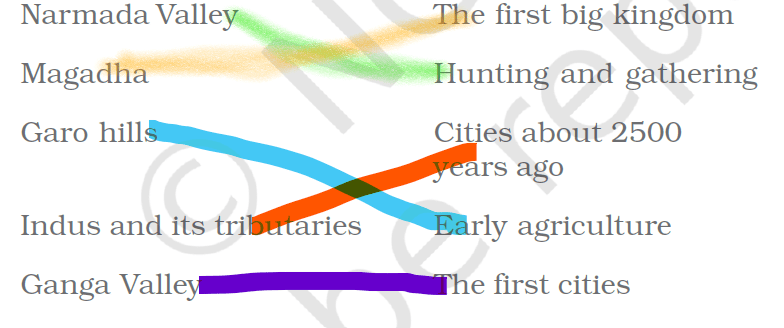
List one major difference between manuscripts and inscriptions?
Manuscripts were written on palm leaf or on specially prepared bark of a tree known as the birch, which grows in Himalayas. Inscriptions were writings on relatively hard surfaces such as stone or metals.
How can we know about the past?
We can know about the past with the help of archaeologists, who look for bones of animals, birds and fish to find out what people ate. They often use sources like manuscripts and inscriptions to find about the past.
Why do you think ordinary men and women did not keep record of what they did?
This could be because the activities done by ordinary men and women were mundane in nature. Since, inscribing one’s activities could have been expensive in nature, there was no record found. It could even be possible that there were certain laws that restricted who could inscribe the events and who could not.
Describe at least two ways in which you think the lives of kings would have been different from those of farmers.
- Lives of kings would have revolved around making decisions that impacted their entire kingdom, like what tax should be paid, solving any cases of injustice. While the lives of farmers would have revolved around their own lands, the crops they would grow etc.
- Kings might have lived lavishly, with lot of servants and leisure activities. Lives of farmers might have involved lot of hardships with little leisure time.
What were the books written in past?
Books in past dealt with all kinds of subjects – religious beliefs and practices, the lives of kings, medicines and science. In addition, there were epics, poems and plays written. I would be interested in reading books about religious beliefs and practice to understand how religion has evolved over a period of time.
Happy Learning 🙂
 Tanubhrt.This.Side
Leave a comment