
Data in the 21st century has come upon as one of the most important things available to us. With internet coming and technology improving, we are now overwhelmed with lots of data, bits, and bytes and now we are going crazy with the prospect of the opportunity that we can actually understand data to make better decisions in our business and in our lives. With this coming of data and the realization that we can actually use it to make wiser decisions, two terms have come to strike a chord with us –
Big Data and Business Intelligence.
There are a lot of differences between the two but then no one can deny that too a certain extent both of them are related to each other! But then how? Well, the only thing that comes to our mind when we think about both of these concepts is the only thing that binds them, yes that is DATA.
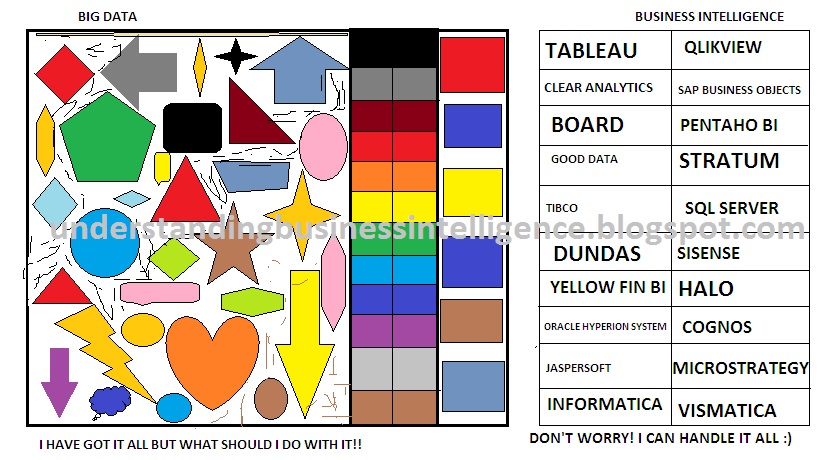
Big Data is used for a large number of data, data that cannot be analyzed using the traditional tools. Business Intelligence refers to the tool and techniques that are used to analyze this data.
Now, if you are completely naïve of what Big Data and Business Intelligence have let us understand it using an example from our daily life.
Suppose, your father goes and get lots of vegetable for you. So, there is ladyfinger, tomato, potato, beans, peas, onions, carrot, cauliflower, cucumber, mushroom and lots more. Now, what are you going to do with this much of vegetable? This raw vegetable is of no use as you cannot eat it directly and it makes no sense to throw it away. Just think about it, your father got this after working hard for a lot of days. It his hard earned money, his consistency in work that you are now able to have it in your home. But then no matter what, the vegetables are of no use until your mother cooks it. Right? Sometimes, your mother will cook a single vegetable, sometimes she will mix two or three of them to bring out a new dish. But the point is that you can have those vegetables only when your mother cooks it right??
This is exactly with big data and business intelligence. Big data refers to the abundant data that is present in our databases, stored in our secondary storage devices. This data can then be structured( that is simple to use, present in form or rows and columns), semi-structured(this means it is present in form of XML files, so there is some information available but then there is not a lot of it available), unstructured data( data is present in form of audios or videos, where the data is not following any predefined structure). It might even be possible that the data that you require is present in different places but in different formats. So, for example somewhere your name is stored in a single column but in others, it is stored in different columns as first name, middle name, and last name. That is your data and you cannot complain about it.
Business Intelligence refers to the tools and techniques that are used to analyze this data and make sense out of it. So, if the data is perfectly fine( which is often not the case in the real-world scenario) and by fine I mean all you need to do is extract the information you require, all you will do is extract the information you require or make the reports or visualizations directly. But then if your data is being required from different sources and you need to do cleaning( as in at some place the data is present in different format but in others it is present in others), you will first do the cleaning using tools like Informatica and then make reports or whatever you want to do.
So, this is the relation between the two. One is the source for the other. You need Big Data to be able to use Business Intelligence but your Business Intelligence is of little use if you don’t have any Big Data.
Happy Learning 🙂
 Tanubhrt.This.Side
Leave a comment