
IN BETWEEN CHAPTER QUESTIONS
What are microorganisms or microbes?
Microorganisms or microbes are living organisms which cannot be seen through a naked eye.
What are the major groups of microorganisms?
Microorganisms are classified into four major groups: bacteria, fungi, protozoa, and some algae.
What are viruses?
Viruses are microscopic and reproduce only inside the cells of the host organisms which may be a bacterium, plant or animal.
What ailments are caused by viruses?
Common ailments like cold, influenza and most coughs are caused by viruses. Also, serious ailments like polio and chicken pox are caused by viruses.
What diseases are caused by protozoa?
Diseases like dysentery and malaria are caused by protozoa.
Name some bacterial diseases.
Typhoid and tuberculosis.
What are the kinds of microorganisms?
Microorganisms can be single-celled like bacteria, some algae, and protozoa or multi-cellular, such as algae and fungi.
Where do microorganisms live?
Microorganisms can survive under all types of environment, ranging from ice cold climate to hot springs and deserts to marshy lands. They are also found inside the bodies of animals including humans. Some microorganisms grow on other organisms while others exist freely. Microorganisms like amoeba can live alone, while fungi and bacteria may live in colonies.
What are the benefits of microorganisms?
Microorganisms are used for various purposes. They are used in the preparation of curd, bread, and cake. They are also used in the cleaning up of an environment. For example, the organic wastes ( vegetable peels, remains of animals, faeces etc) are broken down into harmless and usable substances by bacteria. They are also used in the preparation of medicines. In agriculture, they are used to increase soil fertility by fixing nitrogen.
How is curd formed from milk?
Milk is turned into curd by bacteria.
How is curd formed?
Curd contains several microorganisms. Of these, the bacterium, Lactobacillus promotes the formation of curd. It multiplies in milk and converts it into curd.
Which bacteria is responsible for converting milk into curd?
Lactobacillus
Why is yeast used in the baking industry?
Yeast reproduces rapidly and produces carbon dioxide during respiration. Bubbles of the gas fill the dough and increase its volume. This is the basis of the use of yeast in the baking industry for making pieces of bread, pastries, and cakes.
What is the commercial use of microorganisms?
Microorganisms are used for the large-scale production of alcohol, wine and acetic acid(vinegar).
Which microorganism is used for the production of wine and alcohol?
Yeast is used for the commercial production of alcohol and wine.
How is yeast used to make wine or alcohol?
Yeast is grown on natural sugars present in grains like barley, wheat, rice, and crushed fruit, juices etc. The smell of alcohol as sugar gets converted by yeast.
What is fermentation?
The process of conversion of sugar into alcohol is called fermentation.
Who discovered fermentation?
Louis Pasteur discovered fermentation in 1857.
What are antibiotics?
The medicines which kill or stop the growth of the disease-causing microorganisms are called antibiotics.
Name some antibiotics made from fungi and bacteria.
Streptomycin, tetracycline, and erythromycin are some of the antibiotics made from fungi and bacteria.
Will antibiotics work against cold or flu? If not, why?
No, antibiotics will not work against cold or flu because these are caused by viruses.
How does the body react when a disease containing microbe enters the body?
When a disease-causing microbe enters the body, the body produces antibodies to fight the invader. The body also remembers how to fight the microbe if it enters again. So, if dead or weakened microbes are introduced in a healthy body, the body fights and kills them by producing suitable antibodies. The antibodies remain in the body and we are protected from disease-causing microbes.
Name the diseases that can be prevented from vaccination.
The diseases that can be prevented using vaccination are – cholera, tuberculosis, smallpox, and hepatitis.
Who discovered the vaccine for smallpox.
Edward Jenner discovered the vaccine for smallpox in 1798.
How are vaccines made in present times?
Vaccines are made on a large scale from microorganisms to protect humans and other animals from several diseases.
What are biological nitrogen fixers?
Microbes like bacteria and blue-green algae which are able to fix nitrogen from the atmosphere to enrich the soil with nitrogen and increase its fertility are called biological nitrogen fixers.
How is manure made?
The plant waste gets converted into manure by the action of microbes. The nutrients released in this process can be used by the plants again.
How do microorganisms clean up the environment?
Microorganisms decompose dead organic wastes of plants and animals converting them into simple substances. These substances are again used by other plants and animals. Thus, microorganisms can be used to degrade the harmful and smelly substances and thereby clean up the environment.
What are pathogens?
The disease-causing microorganisms are called pathogens.
How can pathogens enter our body?
Pathogens can enter our body through the air we breathe, the water we drink or the food we eat. They can also get transmitted by direct contact with an infected person or carried through an animal.
What are communicable diseases?
Microbial diseases that can spread from an infected person to a healthy person through the air, water, food or physical contact are called communicable diseases. Examples of such diseases include cholera, common cold, tuberculosis, chicken pox.
How does common cold spreads?
When a person suffering from common cold sneezes, fine droplets of moisture carrying thousands of viruses are spread into the air. The virus may enter the body of a healthy person while breathing.
How does housefly transmit diseases?
The housefly is a carrier of disease-causing microbes. The flies sit on the garbage and animal excreta. Pathogens stick to their body. When these flies sit on the uncovered food they may transfer the pathogens. Whoever eats the contaminated food is likely to get sick.
Who causes malaria?
Female Anapheles mosquito carries the parasites of malaria.
Who causes dengue?
Female Aedes mosquito acts as a carrier of dengue virus.
How can we prevent mosquitoes from breeding?
All mosquitoes breed in water. Hence one should not let water collect anywhere, in coolers, tyres, flower pots etc. By keeping the surroundings clean and dry we can prevent mosquitoes from breeding.
What is the causative micro organism for the following diseases –
Tuberculosis, measles, chicken pox, polio, cholera, typhoid, hepatitis B, malaria.
Tuberculosis – Bacteria
Measles – Virus
Chicken Pox – Virus
Polio – Virus
Cholera – Bacteria
Typhoid – Bacteria
Hepatitis B – Virus
Malaria – Protozoa
What are the general preventive measures for tuberculosis, measles, chicken pox and polio?
Keep the patient in complete isolation.
Keep the personal belonging of the patient away from those of the others.
Vaccination to be given at a suitable age.
What are the general preventive measures for cholera and typhoid?
Maintain personal hygiene and good sanitary habits.
Consume properly cooked food and boiled drinking water.
Vaccination.
What are the general preventive measures for Hepatitis B?
Drink boiled drinking water.
Vaccination.
What are the general preventive measures for malaria?
Use mosquito net and repellents.
Spray insecticides and control breeding of mosquitoes by not water to collect in the surroundings.
What is the mode of transmission for the following diseases –
Tuberculosis, measles, chicken pox, polio, cholera, typhoid, hepatitis B, malaria.
Tuberculosis – Air
Measles – Air
Chicken Pox – Air/Contact
Polio – Air/Contact
Cholera – Water/Food
Typhoid – Water
Hepatitis B – Water
Malaria – Mosquito
Which bacterium causes anthrax disease?
Bacillus anthracis
Who discovered the bacterium causing anthrax disease?
Robert Koch discovered the bacterium (Bacillus anthracis) which causes anthrax disease.
What causes foot and mouth disease in cattle?
Foot and mouth disease in cattle are caused by the virus.
What causes citrus canker in plants?
Citrus canker is caused by bacteria in plants through the air.
What causes rust of wheat in plants?
Rust of wheat is caused by fungi in plants and gets transmitted through air or seeds.
What causes yellow vein mosaic of bhindi in plants?
It is caused by the virus using insect.
How is food poisoning caused?
Food poisoning may be caused due to consumption of food spoilt by microorganisms. Microorganisms that grow on our food sometimes produce toxic substances which make the food poisonous causing serious illness and even death.
Why are salts and edible oil called preservatives?
Salts and edible oils are the common chemicals generally used to check the growth of microorganisms. Therefore they are called preservatives.
Name the chemicals used to preserve jams and squashes.
Sodium benzoate and sodium metabisulphite are the common chemicals used to preserve jams and squashes.
What food items are preserved using common salt?
Common salt is used to preserve meat and fish. Meat and fish are covered with dry salt to check the growth of bacteria. Salting is also used to preserve amla, raw mangoes, tamarind etc.
What kind of food is preserved using sugar?
Jams, jellies, and squashes are preserved using sugar.
How does sugar preserve food?
Sugar reduces the moisture content which inhibits the growth of bacteria which spoils food.
What kind of food is preserved using oil?
Use of oil and vinegar prevents spoilage of pickles because bacteria cannot live in such an environment. Vegetables, fruit, fish, and meat are often preserved using such method.
How is pasteurized milk prepared?
Pasteurized milk is heated to about 70 degree Celsius for 15 to 30 seconds and then suddenly chilled and stored. By doing so, it prevents the growth of microbes. This process is called pasteurization.
Who discovered pasteurization?
Louis Pasteur discovered pasteurization.
What is the use of Rhizobium?
Rhizobium is involved in the fixation of nitrogen in leguminous plants(pulses). It lives in the root nodules of leguminous plants, such as beans and peas with which it has a symbolic relationship.
What percent of nitrogen is present in the environment?
There is 78% of nitrogen in the environment.
Explain the nitrogen cycle?
Our atmosphere has 78% of nitrogen, however, it cannot be consumed directly. Certain bacteria and blue-green algae present in the soil fix nitrogen from the atmosphere and convert into compounds of nitrogen. Once nitrogen is converted into these usable components, it can be utilized by plants from the soil through their roots. Nitrogen is then used for the synthesis of plant proteins and other compounds. Animals feeding on plants get these proteins and other nitrogen compounds.
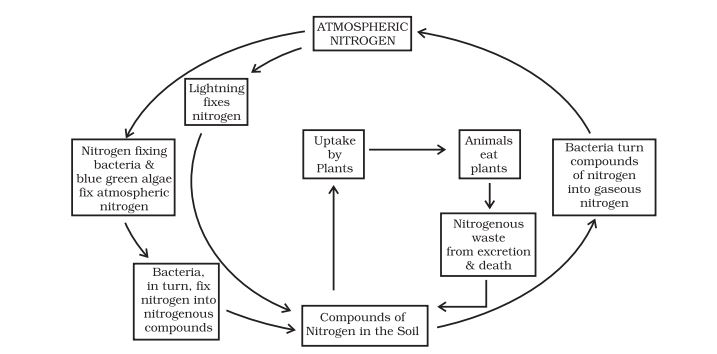
When plants and animals die, bacteria and fungi present in the soil convert the nitrogenous wastes into nitrogenous compounds to be used by plants again. Certain other bacteria convert some part of them to nitrogen gas which goes back into the atmosphere. As a result, the percentage of nitrogen in the atmosphere remains constant.
EXERCISES
Fill in the blanks –
(a) Microorganisms can be seen with the help of a microscope.
(b) Blue-green algae fix nitrogen directly from air to enhance the fertility of the soil.
(c) Alcohol is produced with the help of yeast.
(d) Cholera is caused by bacteria.
Tick the correct answer
–
(a) Yeast is used in the production of
(i) sugar (ii)alcohol (iii) hydrochloric acid (iv) oxygen
alcohol
(b) The following is an antibiotic
(i) sodium bicarbonate (ii) Streptomycin (iii) alcohol (iv) yeast
streptomycin
(c)Carrier of malaria-causing protozoan is
(i) female Anopheles mosquito (ii) cockroach
(iii) housefly (iv) butterfly
female Anopheles mosquito
(d) The most common carrier of communicable diseases is
(i) ant (ii) housefly (iii) dragonfly (iv) spider
housefly
(e) The bread of idli dough rises because of
(i) heat (ii) grinding (iii) growth of yeast cells (iv) kneading
the growth of yeast cells
(f) The process of conversion of sugar into alcohol is called
(i) nitrogen fixation (ii) moulding (iii) fermentation (iv) infection
fermentation
Match the organisms in Column I with their action in Column II
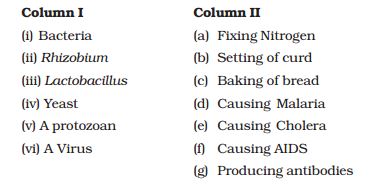
(i) e
(ii) a
(iii) b
(iv) c
(v) d
(vi) f
Can microorganisms be seen with naked eyes? If not, how can they be seen?
Microorganisms cannot be seen with naked eyes. You require a microscope or magnifying glasses to see them.
What are the major groups of microorganisms?
Microorganisms are classified into four major groups: bacteria, fungi, protozoa, and algae.
Name the organisms which can fix atmospheric nitrogen in the soil.
Bacteria and blue-green algae.
Write ten lines on the usefulness of microorganisms in our lives.
- Microorganisms are used in the preparation of curd, bread, and cake.
- A microorganism is used in cleaning up of an environment.
- In agriculture, they are used to increase soil fertility by nitrogen fixation.
- Microorganisms are used in large-scale production of wine, alcohol and acetic acid.
- Microorganisms are used for producing antibiotics.
- They are also used to create manure.
- Microorganisms are used to create vaccines for various diseases.
- They are used to control various plant diseases.
- They are used in the livestock and poultry to check microbial infection in animals.
- Leguminous plants, such as soybeans, peas, clover, alfalfa, and beans, form intimate associations with nitrogen-fixing bacteria like Rhizobium.
Write a short paragraph on the harms caused by microorganisms.
Microorganisms are harmful in many ways. Some of the microorganisms cause diseases in human beings, plants, and animals while others spoil clothing, food, and leather.
What are antibiotics? What precautions must be taken while taking antibiotics?
The medicines which kill or stop the growth of the disease-causing microorganisms are called antibiotics.
Precautions to be taken –
- Antibiotics should be taken only on the advice of a qualified doctor.
- If taken, the course of antibiotics should be completed.
- Antibiotics should not be taken unnecessarily as it may kill the beneficial bacteria in the body.
 Tanubhrt.This.Side
Leave a comment