
When did the East India Company become Diwan of Bengal?
On August 12 1765, the Mughal Emperor appointed the East India Company as the Diwan of Bengal.
What privileges did the company had after becoming the Diwan of Bengal?
As Diwan, the company became the chief financial administrator of the territory under its control. It had to think of administering the land and organising its revenue resources. This was to be done in a way that could meet the growing expenses of the company. As a trading company, they had also to ensure that it could buy the products it needed and sell what it wanted.
What was the primary concern for the Company?
The Company had become the Diwan, but it still saw itself primarily as a trader. It wanted a large revenue income but was unwilling to set up any regular system of assessment and collection. The effort was to increase the revenue as much as it could and buy the fine quality of cotton and silk as cheaply as possible. Within five years, the quantity of goods bought by Company in Bengal doubled. Before 1865, the company had purchased goods in India by importing gold and silver from the Britain. Now, the revenue collected in Bengal could finance the purchase of goods for export.
Why was their shift towards improving agriculture?
During the Diwani of Company in Bengal, Bengal economy was facing crises. Artisans were deserting villages since they were being forced to sell their good to the Company at low prices. Peasants were unable to pay the dues that were demanded from them. Aritsinal production was at decline and agricultural cultivation showed signs of collapse. In 1770, a terrible famine killed ten million people in Bengal, swiping one third of the population.
What was the solution towards improving agriculture?
In 1793, Company introduced Permanent Settlement.
What were the terms of Permanent Settlement?
According to the terms of Permanent Settlement, the rajas and taluqdars were recognised as zamindars. They were asked to collect rent from peasants and pay revenue to the Company. The amount to be paid was fixed permanently, that is, it was not to be increased ever in future.
What was the reason for keeping a fixed payment for the Permanent Settlement?
The Company felt that this would ensure a regular flow of revenue in Company’s coffers and at the same time encourage the zamindars to invest in improving the land. Since the revenue demand of the state would not be increased, the zamindar will benefit from increased production from the land.
What problems did the Zamindars faced because of the Permanent Settlement?
Zamindars were not investing in the improvement of land. The revenue that had been fixed was so high that the zamindars found it difficult to pay. Anyone who failed to pay the revenue lost his zamindari. Numerous zamindars were sold off at auctions organized by the Company.
What problems did the Company face due to Permanent Settlement?
By the first decade of the nineteenth century the situation changed. The prices in the market rose and the cultivation slowly expanded. This meant an increase in the income of the zamindars but no gain for the Company since it could not increase the revenue demand that had been fixed permanently.
What were the problems of the cultivator because of the Permanent Settlement?
In the villages, the cultivator found the system extremely oppressive. The rent he paid to the zamindar was extremely high and his right on the land was insecure. To pay the rent he had to take a loan from the money lender, and when he failed to pay he was evicted from the land he had cultivated for generations.
What was the approach of zamindars once the land started cultivating well?
Even then the zamindars had no interest in improving the land. Some had lost their land in the early years of settlement; others now saw the possibility of earning without the trouble and risk of investment. As long as the zamindars could give out the land to tenants and get rent, they were not interested in improving the land.
Who was the governor-general when Permanent Settlement was introduced?
Charles Cornwallis was the governor-general of India when the Permanent Settlement was introduced.
Who was Holt Mackenzie?
In the north western provinces of Bengal Presidency, an Englishman called Holt Mackenzie devised the new system which came into effect in 1822.
What were the directions given by Holt Mackenzie to revive the revenue system?
Mackenzie felt that village was an important social institution in the north Indian society and needed to be preserved. Under his directions, collectors went from village to village, inspecting the land, measuring the fields and recording the customs and rights of different groups. The estimated revenue of each plot in the village was added up to calculate the revenue that each village had to pay. This demand was to be revised periodically and was not permanently fixed.
What the responsibility of the village headmen in the Mackenzie’s system of revenue?
The charge of collecting the revenue and paying it to the Company was given to the village headmen rather than the zamindar. This system came to be known as mahalwari system.
What is a mahal in British revenue system?
In British revenue system, mahal is a revenue estate which may be a village or a group of villages.
What was the system devised to move away from the idea of Permanent Settlement in South called?
The new system that was devised came to be known as the ryotwar( or ryotwari).
Who applied the ryotwari system in South at a small scale?
The system was tried on a small scale by Captain Alexander Read in some of the areas that were taken by the Company.
Who implemented the ryotwari system at a larger scale?
Thomas Munro gradually extended the system all over in South.
What was different about the villagers in south when compared to North India?
In South, there were no traditional zamindars. The settlement they argued had to be made directly with the cultivators (ryots) who had tilled the land for generations. Their fields had to be carefully and separately surveyed before the revenue assessment was made.
What issues were faced because of the revenue system of Munro?
Driven by the desire to increase the income from land, revenue officials fixed too high a revenue demand. Peasants were unable to pay, ryots fled the countryside, and villages became deserted in many regions.
What were the crops that the British wanted Indians to grow?
By the late eighteenth century, the Company was trying to expand the cultivation of indigo and opium. In the century and half that followed, the Britishers persuaded or forced cultivators in various parts of India to produce other crops : jute in Bengal, tea in Assam, sugarcane in United Provinces, wheat in Punjab, cotton in Maharashtra and Punjab, rice in Madras.
How is the blue colour produced?
The blue is produced from a plant called indigo. India was the biggest supplier of Indigo in the world during the eighteenth century.
Where does Indigo plant grows primarily?
Indigo grows primarily in tropics.
Which countries were using Indian Indigo during thirteenth century?
By thirteenth century, Indian Indigo was being used by the cloth manufacturers in Italy, France and Britain to dye cloth.
On what did the European market depend on for dyes?
Although Indian Indigo was the best, its price was very high and only small amount reached European market. European cloth manufacturers therefore had to depend on another plant called woad to make violet and blue dyes.
Why did the European marketers went for woad?
Being the plant of a temperate zone, woad was more easily available in Europe. It was grown in northern Italy, southern France and in parts of Germany and Britain.
Which one did cloth dyers prefer : woad or indigo? Why?
Cloth dyers preferred indigo as a dye. Indigo produced a rich blue colour, whereas the dye from woad wad dull and pale.
Which European powers started cultivating Indigo?
The French began cultivating indigo in St Domingue in the Caribbean islands, the Portuguese in Brazil, the English in Jamaica and the Spanish in Venezuela. Indigo plantations also came up in many parts of North America.
What led to an emergent need of Indigo?
By the end of the eighteenth century, the demand for Indigo grew further. Britain began to industrialise and its cotton production expanded dramatically, creating an enormous new demand for cloth dyes. While the demand for indigo increased, its existing supplies from West India and America collapsed for a variety of reasons. Between 1783 and 1789 the production of Indigo fell by half in the world.
How did indigo export to Britain increase in the 18th century?
In 1788 only 30 percent of the indigo was imported to Britain from India. By 1810, the proportion had gone up to 95 percent.
What were the main systems of indigo cultivation?
The two main systems of indigo cultivation – nij and ryoti.
What was the nij form of indigo cultivation?
Within the system of nij cultivation, the planter produced indigo in lands that he directly controlled. He either bought the land or rented it from other zamindars and produced indigo by directly employing hired labourers.
On what fields can indigo be planted?
Indigo could be planted only on fertile lands.
What problems did planters face in planting indigo?
Planters found it difficult to expand the area under nij cultivation. Indigo could be cultivated only on fertile lands, and these were all already densely populated. Only small plots scattered over the landscape could be acquired. Planters needed large areas in compact blocks to cultivate indigo in plantations.
Who is a slave?
A slave is a person who is owned by someone else – the slave owner. A slave has no freedom and is compelled to work for the master
What was the problem with nij cultivation on large scale?
Nij cultivation on large scale acquired many ploughs and bullocks. One bigha of indigo cultivation required two ploughs. This meant that a planter with 1000 bighas would need 2000 ploughs. Investing in purchase and maintenance of ploughs was a big problem. Nor could supplies be easily got from the peasants since their ploughs and bullocks were busy on their rice fields.
What is bigha?
Bigha is a unit of measurement of land. Before, British rules, the size of this area varied. In Bengal, the British standardised it to one-third of an acre.
How did the ryoti system work?
Under the ryoti system, the planters forced the ryots to sign a contract, an agreement (Satta). At times they pressurised the village headmen to sign the contract on behalf of the ryots.
What benefits were given to people who signed the contract under ryoti system? What were the problems?
Those who signed the contract were given cash interest from planters at low interest to produce indigo. But the loan committed the ryot to cultivating indigo on at least 25 percent of the area under holding.
How was the indigo plant taken care of?
The planter provided the seed and the drill while the cultivators prepared the soil, sowed the seed and looked after the crop.
Who carried the indigo plants to vats?
Indian women usually carried the plants to vats.
What is a vat?
Vat is a fermenting or storage vessel.
What happened after the indigo harvest?
After harvest, the indigo plants were taken to the vats in the indigo factory.
How many vats were needed to manufacture the dye?
Three or more vats were needed to manufacture the dye.
Did all the required vats had the same function?
Each vat had a separate function.
What was the first step in indigo production?
The leaves stripped off the indigo plant were first soaked in warm water in a vat ( known as the fermenting or the steeper vat) for several hours. When the plant fermented the liquid began to boil and bubble. Now the rotten leaves were taken out and the liquid drained into another vat that was placed just below the first vat.
What is the second vat known as?
The second vat is known as beater vat.
What is the second step in indigo production?
In the second vat, known as the beater vat the solution was continuously stirred and beaten with paddles. When the liquid gradually turned green and then blue, lime water was added to sediment settled at the bottom of the vat and a clear liquid rose to the surface. The liquid was drained off and the sediment – the indigo pulp – transferred to another vat ( known as the setting vat) and then pressed and dried for sale.
How was the ryoti system for the peasants?
When the crop was delivered to the planter after the harvest, a new loan was given to the ryot, and the cycle started all over again. Peasants who were easily tempted by the loans soon realised how harsh the system was. The price they got for the indigo they produced was too low and the cycle of loans never ended.
What was the problem with cultivating indigo?
The planters usually insisted that indigo is cultivated on te best soils in which peasants preferred to cultivate rice. Indigo, moreover had a deep root and it exhausted the soil rapidly. After an indigo harvest, the land could not be sown with rice.
How did the ryots fight against the injustice done to them?
In March 1859 thousands of ryots in Bengal refused to grow indigo. As the rebellion spread, ryots refused to pay rents to the planters and attacked and attacked indigo factories armed with sword and spears, bows and arrows. Women turned upto fight with pots, pans and kitchen implements.
How did people behave with those who worked with planters?
Those who worked for the planters were socially boycotted and the gomasthas – agents of planters – who came to collect rent were beaten up. Ryots swore they would no longer take advances to sow indigo nor be bullied by the planters lathiyals – the lathi – wielding strongmen maintained by the planters.
What made the indigo ryots to go for the Blue Rebellion?
In 1859, the indigo ryots felt that they had the support of the local zamindars and village headmen in their rebellion agains the planters. In many villages, headmen who had been forced to sign the indigo contracts, mobilised the indigo peasants and fought pitched battles with the lathiyals. In other places, even the zamindars went around villages urging the ryots to resist the planters. These zamindars were unhappy with the increasing power of the planters and angry at being forced by the planters to given them land on long leases.
What were the circumstances which lead to the ultimate collapse of indigo production in Bengal?
The indigo peasants imagined that the British government will support them in their struggle against the planters. The British government was worried about another rebellion after the Revolt of 1857 and so the Lieutenant Governor toured the region in the winter of 1859. The ryots saw the tour as a sign of government sympathy for thier plight. When in Barasat, the magistrate Ashley Eden issued a notice stating that the ryots would not be compelled to accept indigo contracts, word went around that Queen Victoria had declared that indigo need not to be sown.
As the rebellion spread, intellectuals from Calcutta rushed to the indigo districts. They wrote of the misery of the ryots, the tyranny of the planters and the horrors of the indigo system.
How did the Government reach to the Blue Rebellion?
The government was worried with the rebellion and brought in the military to protect the planters from assault and set up the Indigo Commission to enquire into the system of Indigo Production. The Commission held the planters guilty and criticised them for the coercive methods they used with indigo cultivators. It declared that indigo production was not profitable for ryots. The Commission asked the ryots to fulfill their existing contracts but also told them that they could refused to produced indigo in future.
Where did indigo plantation began after it stopped in Bengal?
After the revolt, indigo production collapsed in Bengal. But the cultivators, shifted towards Bihar.
What led to the beginning of Champaran movement?
When Mahatma Gandhi returned from South Africa, a peasant from Bihar persuaded him to visit Champaran and see the plight of the indgo cultivators there. Mahatma Gandhi’s visit in 1917 marked the beginning of the Champaran movement against the indigo planters.
What does the following image depict?
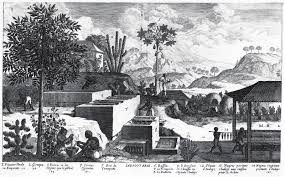
The image shows all the stages of indigo production in the French slave plantation of the Caribbean islands.
The slave workers are putting the indigo plant into the settler vat on the left. Another worker is churning the liquid with a mechanical churner in a vat. Two workers are carrying the indigo pulp hung up in the bags to be dried. In the foreground two others are mixing the indigo pulp to put into the moulds. The planter is at a centre of the picture standing on the high ground supervising the slave workers.
Match the following – :
| COLUMN 1 | COLUMN 2 |
|---|---|
| ryot | peasant |
| mahal | village |
| nij | cultivation on planter’s own land |
| ryoti | cultivation on ryot’s land |
Fill in the blanks – :
- Growers of woad in Europe saw indigo as a crop which would provide competition to their earnings.
- The demand for the indigo increased in late eighteenth century Britain because of industrialisation
- The international demand for Indigo was affected by the discovery of b.
- The Champaran movement was against indigo plantation.
 Tanubhrt.This.Side
Leave a comment