
Who was the last powerful Mughal ruler?
Aurangzeb was the last of the powerful Mughal rulers.
What does the following picture depict?
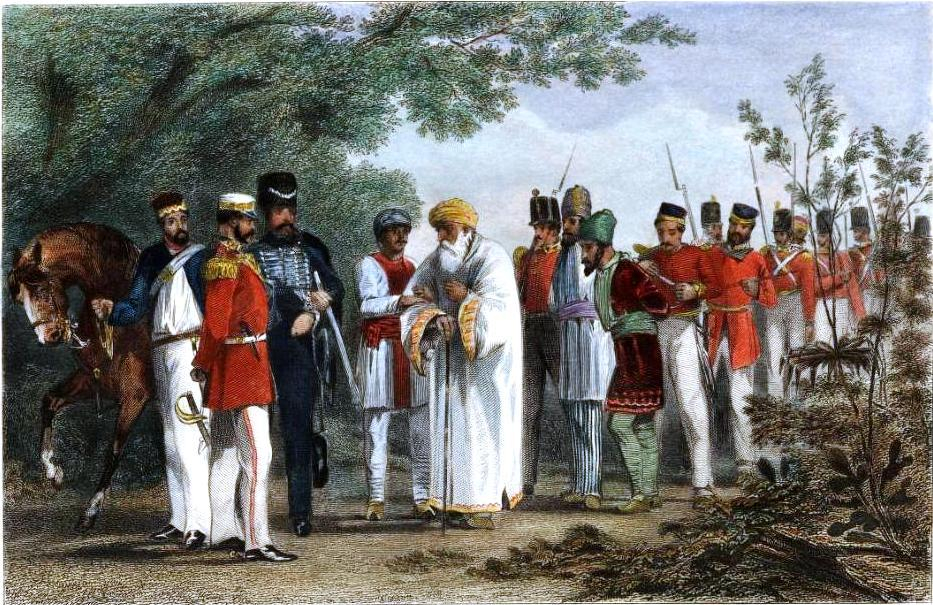
The image depicts Bahadur Shah Zafar and is sons being arrested by Captain Hodson.
Who was the last emperor of Mughal empire?
Bahadur Shah Zafar was the last emperor of Mughal empire.
How did Bahadur Shah Zafar die?
In 1857, a massive rebellion broke out against Britishers and Bahadur Shah Zafar was seen as the natural leader. Once the Britishers put down the rebellion, he was forced to leave the kingdom and his sons were shot in cold blood.
When did the East India Company get the power to trade with te East?
In 1600, the East India Company acquired a charter from the ruler of England, Queen Elizabeth I, granting it the sole right to trade with the East.
What was the significance of the charter given to the East India Company?
The charter meant that no other trading group in England could compete with the East India Company. Wit this charter, the Company could venture across oceans, looking for new lands from which it could buy goods at a cheap price, and carry them back to Europe to sell at higher prices.
How did Mercantile companies trade in earlier days?
Mercantile companies made profit primarily by excluding competition so that they could buy cheap and sell dear.
What is meant by Mercantile?
A business enterprise that makes profit primarily through trade, buying goods cheap and selling them at higher prices.
Who discovered the sea route to India?
Vasco da Gama, a Portuguese explorer discovered the sea route to India in 1498.
What was the sea route discovered by Vasco Da Gama?
From the west coast of Africa, round the Cape of Good Home crossing the Indian Ocean.
Which European powers were interested in trading with India?
Britishers, Portuguese, Dutch, French
What were the European trading companies interested in trading with India?
All the trading companies were interested in the fine qualities of cotton and sikl produced in India. Pepper, cloves, cardamom and cinnamon too were in great demand.
What led to battles between the European trading companies?
All the trading companies were interested in buying the same things from India. Competition amongst the European companies inevitably pushed up the prices at which the goods could be purchased, and this reduced the profits that could be earned. The only way the trading companies could flourish was by eliminating rival competitors. The urge to secure markets, therefore, led to fierce battles between the trading companies.
How did the trade happen in the 17th and 18th century?
Through the seventeenth and eighteenth centuries trading companies regularly sank each other’s ships, blockaded routes, and prevented rival ships from moving with supplies of goods. Trade was carried on with arms and trading posts were protected through fortification.
Where was the first English factory set up in India?
The first English factory was set up on the banks of the river Hugli in 1651.
What were company’s traders called?
Company’s traders were called factors at that time.
How did East India Company grow its base in India?
East India Company had a warehouse where goods for export were stored, and it had offices where Company’s officials sat. As trade expanded, the Company persuaded merchants and traders to come and settle near the factory. By 1696, it began building a fort around the settlement. Two years later it bribed Mughal officials into giving the Company Zamindari rights over three villages.
What is the meaning of farman?
A royal edict or a royal order.
How did the Nawabs of Bengal react to the increasing autonomy of the Company?
They refused to grant the company concessions, demanded large tributes for the Company’s right to trade, denied it any right to mint coins and stopped it from extending its fortifications. Accusing the company of deceit, they claimed that the Company was depriving the Bengal government of huge amounts of revenue and undermining the authority Nawab. It was refusing to pay taxes, writing disrespectful letters and trying to humiliate the Nawab and his officials.
How did the East India Company react to the orders by Bengal government?
The company declared that the unjust demands of the local officials were ruining the trade of the Company and trade could flourish only if the duties were removed.
What is the meaning of puppet?
Puppet means toy that you can move with strings. The term is used disapprovingly to refer to a person who is controlled by someone else.
When did Alivardi Khan die? Who succeeded him?
Alivardi Khan died in 1756 and Sirajuddaulah became the Nawab of Bengal.
Why was the Battle of Plassey fought?
The Company was trying to meddle in the matters of the government which Sirajuddaulah did not approve of. After negotiations failed, the Nawab marched with 30000 soldiers to the English factory at Kassimbazar, captured the company’s officials, locked the warehouse, disarmed the Englishmen, and blockaded English ships. Then he marched to Calcutta to establish control over te Company’s fort there.
On hearing the news of fall of Calcutta, Company’s officials in Madras sent forces under the command of Robert Clive, reinforced by naval fleets. Finally in 1757, after long negotiations, Robert Clive led the Company’s army against Sirajuddaulah at Plassey.
Why did Indians lose the Battle of Plassey?
One of the main reasons for the defeat of Nawab at Plassey was that the forces led by Mir Jafar, one of the Sirajuddaulah’s commanders, never fought the battle. Clive had managed to secure his support by promising to make him Nawab after crushing Sirajuddaulah.
Why did Battle of Plassey become famous?
Battle of Plassey became famous because it was the first major victory the Company won in India.
How did the East India Company work with the puppet nawabs?
It was difficult for the puppet nawabs to help the Company everytime as they also had to maintain a basic appearance of dignity and sovereignty. So, when Mir Jafar protested, the company deposed him and installed Mir Qasim in his place. When Mir Qasim complained, he was defeated in the Battle of Buxar(1764), driven out of Bengal and Mir Jafar was reinstalled. The Nawab had to pay Rs 500,000 every month but the company wanted more money to finance its wars, and meet the demands of trade and its other expenses. The company wanted more money and more revenue. So, when Mir Jafar died in 1765, Robert Clive declared: “We must indeed become nawabs ourselves”.
When did the company first acquired rights over a territory in India?
In 1765, the Mughal Emperor appointed the Company as the Diwan of the provinces of Bengal.
How was the company acting after the win at Battle of Buxar?
After the Battle of Buxar, the Company appointed Residents in Indian states. They were political or commercial agents and their job was to serve and further the interests of the Company. Through the residents, the Company officials began interfering in the internal affairs of Indian States. They tried to decide who was to be the successor to the throne and who was to be appointed in administrative posts. They even forced states to come into a subsidiary alliance.
What were the terms of the subsidiary alliance?
According to the terms of the subsidiary alliance, Indian rulers were not allowed to have their independent armed forces. They were to be protected by the Company, but had to pay for the subsidiary forces that the Company was supposed to maintain for the purpose of this protection. If the Indian rulers failed to make the payment then part of their territory was taken away as a penalty.
Who is regarded as the Tiger of Mysore?
Tipu Sultan
Who were the rulers of Mysore?
Mysore had grown in strength under the leadership of powerful rulers like Haidar Ali and his famous son Tipu Sultan. How did Mysore trade with Company?
How did Mysore trade with Company?
Mysore controlled the profitable trade of the Malabar coast where the Company purchased pepper and cardamom.
How did Tipu Sultan react to the trade with the Company?
In 1785, Tipu Sultan stopped the export of sandalwood, pepper and cardamom through the ports of his kingdom, and disallowed local merchants from trading with the company. He also established a close relationship with the French in India and modernised his army with their help.
How many battles were fought with Mysore?
The company fought four battles with Mysore. Only in the last – the Battle of Seringapatnam – did the company ultimately win a victory.
How did Tipu Sultan die?
Tipu Sultan died defending his capital Seringapatnam.
What happens after the victory of the Company over Mysore?
Mysore was placed under the former ruling dynasty of the Wodeyars and a subsidiary alliance was imposed on the state.
Explain the below picture.

This is the picture of a big mechanical toy that Tipu possessed. Here, a tiger is mauling a European soldier. When it’s handled was turned the toy tiger roared and the soldier shrieked.
Where is Tipu’s toy tiger kept now?
The toy tiger is kept in the Victoria and Albert Museum in London. The British took it away when Tipu Sultan died defending his capital Seringapatnam on 4 May 1799.
What was the capital of Mysore when Tipu Sultan was its ruler?
Seringapatnam
How did the Britishers win the battle against Tipu Sultan?
The Company forces were defeated by Haidar Ali and Tipu Sultan in several battles. But in 1792, attacked by the combined forces of the Marathas, the Nizam of Hyderabad and the company, Tipu was forced to sign a treaty with the British by which two of his sons were taken away as hostages.
When did Tipu Sultan become the ruler of Mysore?
1782
Why is Tipu Sultan called the Tiger of Mysore?
It is said that once Tipu Sultan went hunting in the forest with a French friend. There he came face to face with a tiger. His gun did not work and his dagger fell to the ground. He battled with the tiger unarmed until he managed to reach down and pick up the dagger. Finally, he was able to kill the tiger in the battle. After this, he came to be known as “Tiger of Mysore”.
He had the image of the tiger on his flag.
When did the Company defeat the Maratha Power?
The company defeated Marathas in the Third Battle of Panipat in 1761.
What happened after the defeat of Maratha?
With the defeat of Maratha in the Third Battle of Panipat in 1761, the Maratha’s dream of ruling Delhi was shattered. They were divided into many states under different chiefs belonging to dynasties such as Sindhia, Holkar, Gaikwad and Bhonsle. These chiefs were held together in a confederacy under a Peshwa who became its effective military and administrative head based in Pune.
Name two famous Maratha soldiers?
Mahadji Sindhia and Nana Phadnis were two famous Maratha soldiers and statesmen of the late eighteenth century.
How did Maratha lose from the Britishers?
The Marathas were subdued in a series of wars. In the first war that ended in 1782 with the Treaty of Salbai, there was no clear victor. The Second Anglo-Maratha War was fought on different fronts, resulting in the British gaining Orissa and the territories north of the Yamuna river including Agra and Delhi. Finally, the third Anglo-Maratha War of 1817-19 crushed Maratha power. The Peshwa was removed and sent away to Bithur near Kanpur with a pension.
Under whom was the policy of paramountcy initiated?
It was under Lord Hastings (General from 1813 to 1823) the policy of paramountcy was initiated.
What was the policy of paramountcy about?
According to the policy of paramountcy, the Company claimed that its authority was paramount or supreme; hence its power was greater than that of Indian states. So, in order to protect its interests, it was justified in annexing or threatening to annex any Indian Kingdom.
Why did Britishers annexed the northern states of India?
East India Company became worried about Russia. It imagined that Russia might expand across Asia and enter India from north-west. Driven by this fear, the British now wanted to secure control over the north-west. They fought a prolonged war with Afghanistan between 1838 and 1842 and established indirect Company Rule. Sind was taken over in 1843. With the death of Maharaja Ranjit Singh, Punjab was annexed in 1849.
For what duration was Lord Dalhousie the Governor-General of India?
1848 to 1856
What was the Doctrine of Lapse?
The doctrine declared that if an Indian ruler died without a male heir his kingdom would lapse, that becomes part of Company territory.
How was Awadh annexed?
While annexing Awadh, the company gave an added argument that they were “obliged by duty” to take over Awadh in order to free the people from the misgovernment of the Nawab.
Who was the first British Governor General?
Warren Hastings
How were the Britishers ruling India in the late eighteenth century?
By this time, the Company had acquired power not only in Bengal but also in Bombay and Madras. British territories were broadly divided into administrative units called Presidencies. There were three Presidencies: Bengal, Madras and Bombay. Each was ruled by a Governor. The supreme head of the administration was the Governor-General.
What was the new system of justice established from 1772?
From 1772, a new system of justice was established. Each district was to have two courts – a criminal court and a civil court.
Who is a Qazi?
Judge
What is the meaning of Mufti?
Mufti is a jurist of the Muslim community responsible for te expounding law that the Qazi would administer.
What is the meaning of Impeachment?
Impeachment is a trial by the house of lords in England for charges of misconduct brought against the person in the House of Commons.
What was the main job of the Collector?
The main job of the collector was to collect revenue and taxes and maintain law and order in his district with the help of judges, police officers and darogas. His office – the Collectorate – became the new centre of power and patronage that steadily replaced previous holders of authority.
What was the Mughal army composed of?
The Mughal army was mainly composed of cavalry and infantry, that is paidal soldiers. They were given training in archery and the use of the sword. The cavalry dominated the army and the Mughal state did not feel the need to have a large professionally trained infantry. The rural areas had a large number of armed peasants and the local zamindars often supplied the Mughals with the paidal soldiers.
Why did the cavalry requirement decline in the British army?
The cavalry requirement declined because the British Empire was fighting in Burma, Afghanistan and Egypt where soldiers were armed with muskets and matchlocks. The soldiers of the Company’s army had to keep pace with changing military requirements and its infantry regiments now became more important.
What is the meaning of musket?
A musket is a heavy gun used by the infantry soldiers.
What is the meaning of matchlock?
Matchlock is an early type of gun where the powder was ignited by a match.
When did the Dutch trading ships reach southern Africa?
The Dutch trading ships reached southern Africa in the seventeenth century.
LET’S RECALL
Match the following :
| COLUMN 1 | COLUMN 2 |
|---|---|
| Diwani | right to collect land revenue |
| Tiger of Mysore | Tipu Sultan |
| faujdari adalat | criminal court |
| Rani Channamma | led an anti-British movement in Kitoor |
| Sipahi | Sepoy |
Fill in the blanks:
- The British conquest of Bengal began with the Battle of Plassey
- Haidar Ali and Tipu Sultan were the rulers of Mysore
- Dalhousie implemented the Doctrine of Lapse
- The Maratha Kingdom were located mainly in western part of India.
State whether true or false:
- The Mughal empire became stronger in the eighteenth century. False
- The English East India Company was the only European company that traded with India. False
- Maharaja Ranjit Singh was the ruler of Punjab. True
- The British did not introduce administrative changes in the territory they conquered. False
 Tanubhrt.This.Side
Leave a comment